
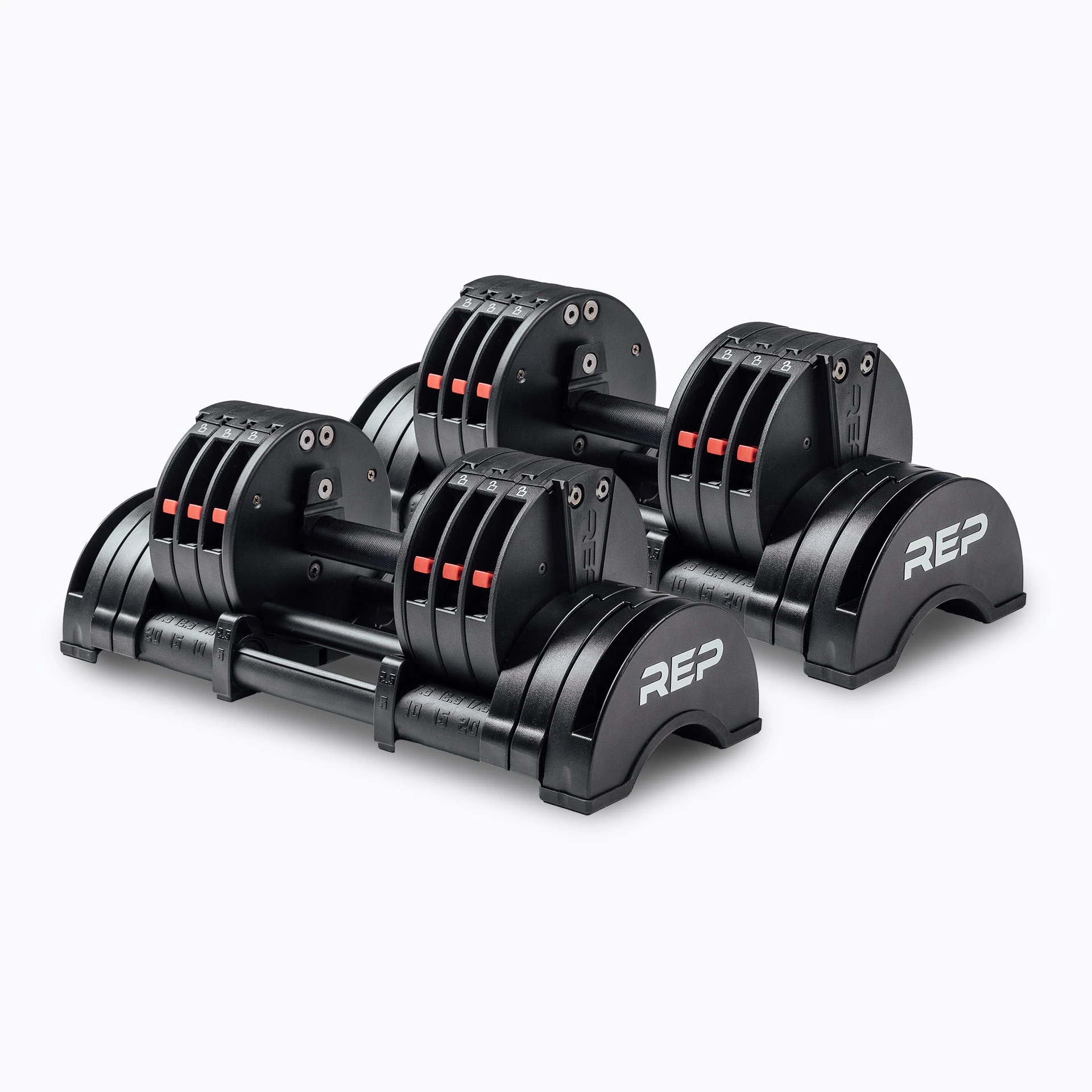
Your needs, this model
Does it fit your priorities?
Can I reach forty-four pounds per hand with switches and balanced gaps no greater than six pounds?
Yes. Twenty kilograms is about 44.09 pounds and the nominal balanced 2.5 kg step is about 5.51 pounds.
Explore this need in the finder →Does the complete documented progression have gaps no greater than five pounds?
No. Its balanced 2.5 kg progression has steps of about 5.51 pounds; the single-micro arrangement has larger gaps.
Explore this need in the finder →Is an exact native twenty-kilogram setting supplied with equal end loads?
Yes. Twenty kilograms is the advertised balanced endpoint of this metric package.
Explore this need in the finder →The QuickDraw 20 kg pair gives metric users a useful middle capacity without starting at the longest version in the range. Its nominal 2.5–20 kg span can cover both light work and moderately heavier exercises, while the shared platform leaves room to expand later. The decision turns on whether 20 kg in each hand meets your present needs and whether you like making weight changes with visible switches and internal micro plates.
Where 20 kg sits among the packages
Twenty kilograms is approximately 44.1 pounds. This is therefore a different supplied configuration from the 40-pound QuickDraw, even though both versions have a 14.3-inch listed loaded length. REP adds material inside the kilogram plates to create the metric range. Matching dimensions are not evidence of matching weights.
For a routine written in kilograms, that distinction is helpful. You can follow the advertised 2.5 kg balanced progression rather than repeatedly converting a pound-based dial or switch setting. For a routine that depends on exact pound loads, it is a reason to choose the pound family instead. The metric package's 2.5 kg starting selection is nominally about 5.5 pounds, not an advertised exact five-pound setting.
The 15 kg pair is shorter at its supplied maximum but stops lower. The 25 kg pair supplies another five kilograms per hand and is longer. If a single current exercise needs 22.5 kg, do not let the future upgrade route obscure the immediate limit of the 20 kg box.
Plan for both switches and micro weights
Outer plate selection uses steel Lock-N-Load switches. Matching changes at the two ends produce the larger 5 kg moves. Two supplied 1.25 kg internal plates make the balanced 2.5 kg increments. A change involving those plates takes a different action from a switch-only change, which matters when comparing this system with a handle-twist set.
REP also describes using one micro plate for a smaller 1.25 kg addition, with a slight imbalance. That can suit someone comfortable with the arrangement, but it should not be confused with the balanced progression. If equal loading at both ends is essential, assess the 2.5 kg steps. Do not infer a uniform balanced 1.25 kg ladder simply from the mass of one internal plate.
Before each lift, check the intended selections and secure the internal plates. The official QuickDraw instructions tell users to lock the plates through the chosen weight when increasing the load and to inspect the dumbbells for damaged, loose or worn parts. A visible mechanism makes that inspection accessible; it does not make the check unnecessary.
Grip fit and tray space still matter
The 32 mm handle is knurled metal rather than a cushioned contour. REP lists 5.4 inches of handle length without the internal micro plates and 4.9 inches with them attached. Use that smaller opening when judging hand clearance for a routine that frequently uses the micro weights. A comfortable bare-handle opening does not automatically describe every loaded arrangement.
Each cradle is 20.6 by 8.45 inches, so two stable resting locations are needed. The dumbbell's 14.3-inch loaded length should not be used as the storage measurement. The seated assembly is listed at 7.9 inches high, with more clearance needed for your hand and the lift-out motion. A stand or cart is sold separately.
A staged purchase with a defined destination
The metric family has documented add-ons that take a smaller package toward 25 and 30 kg per hand. Expansion means fitting the correct extra plates and removing corresponding cradle spacers; it does not require changing to a different selection system. That makes this stage practical when 20 kg is sufficient now and future needs remain uncertain.
Choose the 30 kg package if you already need that ceiling, or compare the SNODE AD80 if greater pound capacity matters more than a metric ladder and low starting weight. QuickDraw 20 kg suits a metric routine within its supplied range and an owner who accepts the switch-plus-micro adjustment process. It is less compelling if you need an exact five-pound start or want every weight change made with one control.
Sources: REP US QuickDraw kilogram specifications; metric expansion plates.
Key details at a glance
| Starting load used for comparison | 5.51 lb per hand |
|---|---|
| Included maximum | 44.09 lb per hand |
| Weight change | switch_micro |
| Supplied grip surface | knurled |
| Grip diameter | 32 mm |
| Full-load length | 14.3 in |
| Supported upgrade beyond this package | Yes |
| Supplied configuration | Two 20 kg QuickDraw dumbbells, two cradles and two internal micro plates per dumbbell. Stand/cart and later expansion plates are separate. |
Use the exact model’s instructions for operating limits, supplied equipment and version differences.
Sources for this assessment
- Current exact US QuickDraw KG product and four supplied size variants
- Original QuickDraw DB-6000 user instructions 45-0149-V1, ten PDF pages
- Original pound upgrade instructions 45-0179-V1, eight PDF pages
- DB-6500 version A, 3/14/2024 official three-page spares sheet
- Current exact KG add-on page
- Public manufacturer adjustable-dumbbell support category with original manual links
Put the lightest and heaviest loads together.
Add the adjustment method, an exact selection or a grip requirement when it matters.