
Your needs, this model
Does it fit your priorities?
Can this complete pair reach 120 pounds per hand with manual plate changes?
Yes. The original 75 lb pair and 120 lb expansion together provide that ceiling; the accessory box alone does not.
Explore this need in the finder →Will the fully loaded dumbbell fit a maximum length of 18 inches?
No. The stated full-load length is 18.25 inches, before allowing space for changing the screws.
Explore this need in the finder →Can I require 2.5-pound steps and matching loads at both ends?
No. Matching ends give five-pound steps. The documented half-step method places one extra plate at one end.
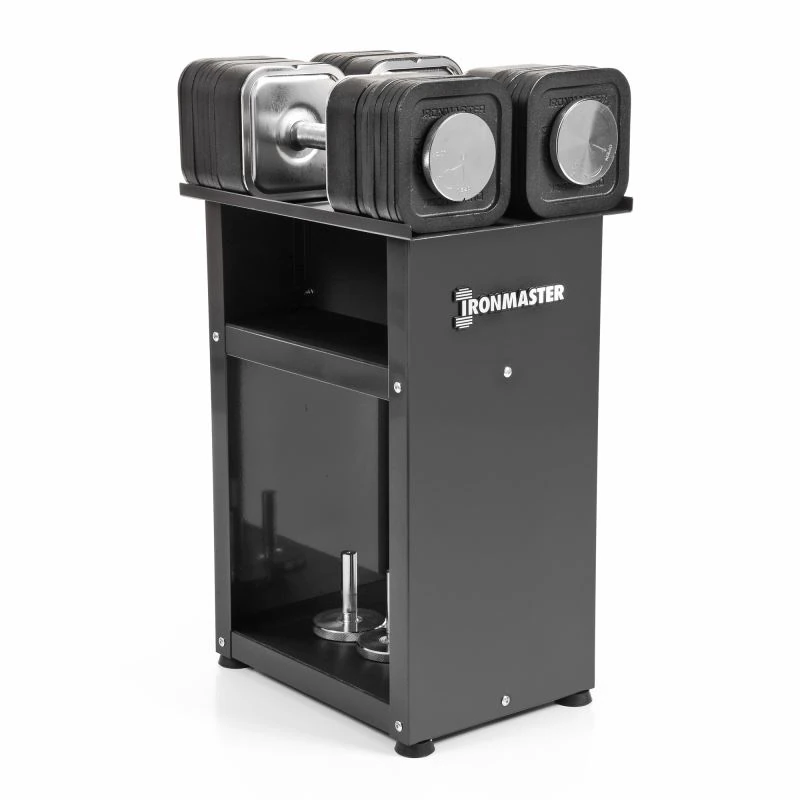
Explore this need in the finder →The Ironmaster Quick-Lock 120-pound configuration suits a home lifter who has genuinely outgrown the original 75-pound pair and accepts moving plates between sets. This is the complete original 75-pound system together with the 120-pound add-on kit, rather than a claim that the add-on box contains two ready-to-use dumbbells. Its appeal is substantial capacity on the same open handles, with the smaller original plates still available for intermediate loads.
What makes a complete 120-pound pair
The expansion supplies four 22.5-pound plates and four longer locking screws. Each dumbbell receives two large plates, adding 45 pounds to its original 75-pound maximum. A buyer starting with the 45-pound set needs the missing original plate inventory as well; purchasing the 120 kit alone does not turn that smaller package into the configuration reviewed here.
Keep both screw sets. The original instructions describe a ten-pound handle-and-screws assembly, while the longer screws belong to the heavier loading arrangements. The current product page describes their supported range as 70–120 pounds; the older linked add-on sheet says above 75. Using the original screws for the lower range and consulting Ironmaster about the transition avoids treating a long screw as a universal replacement at every load.
More capacity changes the adjustment routine
The large plates work alongside the original five- and 2.5-pound plates. Ironmaster suggests putting the big plates nearest the handle, then changing smaller plates outside them. That arrangement makes sense when several consecutive sets use heavy loads: the large central portion can remain assembled while the outer plates change. Moving between very light and very heavy exercises still involves rebuilding both ends of both dumbbells.
With matching plates at the ends, the assembled system supports five-pound progression. The original manual also describes a 2.5-pound half step made by putting one extra plate at one end and moving the hand slightly toward that end. Those are different loading arrangements. Someone requiring identical end loads should use the five-pound ladder rather than assume every smaller step remains symmetrical.
Check length and the changing surface
Ironmaster gives a full-load length of 18.25 inches at 120 pounds. That is a useful planning measurement, but it does not include the surface needed to lay out plates and remove screws. A narrow shelf that holds the finished pair can still be awkward for changing weights. Plan a firm, level working surface and accessible storage for both screw lengths before choosing a stand.
The open knurled handles avoid the side rails found on some nested systems. Whether that suits a particular exercise depends on hand position and the assembled end plates; it is not a promise that a long, heavy dumbbell will clear every body position. The original handles provide 6.5 inches of grip length. Adding the separate Heavy Handle kit changes that space and the starting load, so those specifications should not be mixed into this version.
Ownership requires attention to the locks
Quick-Lock screws release by aligning their indicators with the handle notches, then pulling them out. They are tightened by hand after the plates seat together. The manual calls for checking tightness between sets and warns against overtightening with tools. A lock that will not engage correctly needs inspection and the manufacturer's troubleshooting process, rather than extra force to finish a workout.
The plate orientation also matters: the Ironmaster lettering faces outward so the plates interlock. Keep the changing area clear, clean the internal threads as directed, and address worn or damaged parts. Neither the metal construction nor the size of the locking screws removes those maintenance checks.
Choose the upgrade for the work you actually do
For sets that remain below 75 pounds, the original 75-pound pair gives the same basic adjustment approach with a shorter maximum assembly. For a 135-pound ceiling and a deliberately heavier starting configuration, consider the 120 system with Heavy Handles. The PowerBlock Pro 100 EXP offers a selector-based alternative up to 100 pounds when changing plates is the larger inconvenience.
Choose this 120-pound Ironmaster arrangement for its useful extension of an existing plate system, especially when you can organize training around fewer large weight changes. It is less persuasive as a first purchase for someone who needs frequent lightweight selections, fast shared adjustments or a compact full-load length above all else.
Key details at a glance
| Starting load used for comparison | 10 lb per hand |
|---|---|
| Included maximum | 120 lb per hand |
| Weight change | screw |
| Supplied grip surface | knurled |
| Grip diameter | 31.75 mm |
| Full-load length | 18.25 in |
| Supported upgrade beyond this package | Yes |
| Supplied configuration | Complete configuration: original 75 lb pair plus 120 lb add-on kit, including four 22.5 lb plates and four longer screws. The add-on box alone is not a pair. |
Use the exact model’s instructions for operating limits, supplied equipment and version differences.
Sources for this assessment
Put the lightest and heaviest loads together.
Add the adjustment method, an exact selection or a grip requirement when it matters.