
Your needs, this model
Does it fit your priorities?
Would this MX30 appear in the current purchase finder?
No. Its exact seller page called it last year’s model and showed sold out; it is retained for comparison but marked reference-only, so the finder excludes it from a buying match.
Explore this need in the finder →Does the MX30 documentation identify a balanced 20 lb standard setting?
Yes. The official guide and exact listing identify ten standard 2.5 lb increments from 7.5 to 30 lb, including 20 lb. This confirms a historical product fact, not present availability; reference-only status still excludes a shortlist match.
Explore this need in the finder →Can an offset-only MX30 total such as 8.75 lb satisfy an equal-end requirement?
No. The seller lists 8.75 lb among one-end offsets, not among the standard equal-end settings. The user guide also tells owners to adjust both ends and does not explain this offset. The library keeps it excluded from current matches in any case.
Explore this need in the finder →The MX30 is the prior-generation, compact member of MX Select’s Rapid Change line: the U.S. distributor describes a 7.5–30 lb pair with contoured grips and yellow dials. It is useful to keep in a library because its lower start and smaller range differ from the newer EVO options. It is not a present buying pick: the exact listing calls it “last years model” and showed sold out when checked. MX Select’s page also says the MX30 cannot use the EVO magnetic add-on weights.
A deliberately light ceiling and a 2.5 lb standard ladder
The supplied system is sold as a pair, with a cradle for each dumbbell. The official MX Select product guide identifies the MX30 at 7.5 lb minimum and 30 lb maximum per hand. Its ten ordinary dial positions are 7.5, 10, 12.5, 15, 17.5, 20, 22.5, 25, 27.5 and 30 lb. The guide shows ten 1.25 lb plates per side and a 2.5 lb balanced increment. That gives a useful small start for pressing, raises and other movements where heavier loads would not necessarily be the objective, but a 30 lb included maximum is a firm limit for heavier rows and presses. It is not a 55 lb MX55 or a 70/100 lb EVO system in a smaller package.
If a compact pair is appealing, compare the actual selection method and starting weight rather than treating every dial dumbbell alike. For a lighter start with a larger ceiling, the PowerBlock Sport 24 starts at 3 lb and reaches 24 lb; the Core Home Fitness 5–50 adds a much higher per-hand endpoint but begins at 5 lb. The MX30’s 7.5 lb first position and 30 lb maximum sit between those capacities, but its selector-and-cradle routine is distinct.
Do not turn the offset claim into an equal-end promise
The clearance page separately advertises nine offset totals—8.75, 11.25, 13.75, 16.25, 18.75, 21.25, 23.75, 26.25 and 28.75 lb—made by moving one end dial one click. This is a different loading arrangement from the ten standard balanced settings. The arithmetic is plausible from the stated 1.25 lb plate weight, but those nine values require unequal selector positions at the two ends; they are not equal-end settings at 1.25 lb intervals.
There is an important instruction conflict to preserve. The distributor’s MX30 page promotes offset loading, while the official MX Select assembly and user guide names “MX30, MX55 & MX85,” says to make selector changes only with the handset in its cradle, and says to adjust both ends to the desired training weight. It does not explain the advertised MX30 offset routine. I would count the ten ordinary equal-end dial settings as the unambiguous standard plan, and would not rely on an asymmetric offset or call it manufacturer-approved without confirming the instructions for the exact unit. If equal loading is essential, the offset numbers do not meet that need in any event.
Legacy accessories are not EVO accessories
The exact page explicitly warns that this prior-year MX30 is incompatible with EVO 1.25 lb and 2.5 lb add-on plates. A separate MX Select stand page distinguishes the earlier MX30/55/85 stand from the newer EVO stand; neither should be presumed to fit the other generation. The exact MX30 description says the stand and adjustable bench are optional, not included. Do not budget for an EVO kit as a route to expand this pair, and do not infer a supported legacy endpoint from generic copy about adding weight to one handle. No verified MX30-specific expansion package or higher maximum is established here.
Setup, handling and fit details
The official guide provides a real assembly and adjustment routine for the named MX30 family. It says the selector dial should only be changed while the dumbbell is seated in its weight cradle; release the selector, rotate to the intended setting, and press it back into its locked position before lifting. It also instructs owners to assemble the cradle feet firmly, check their screws, and position the cradles before loading the handsets. MX Select says the system is for home use, warns against dropping, throwing or striking the units together, and says not to use a malfunctioning selector. Those are meaningful ownership limits for any used pair, not claims that the mechanism is maintenance-free.
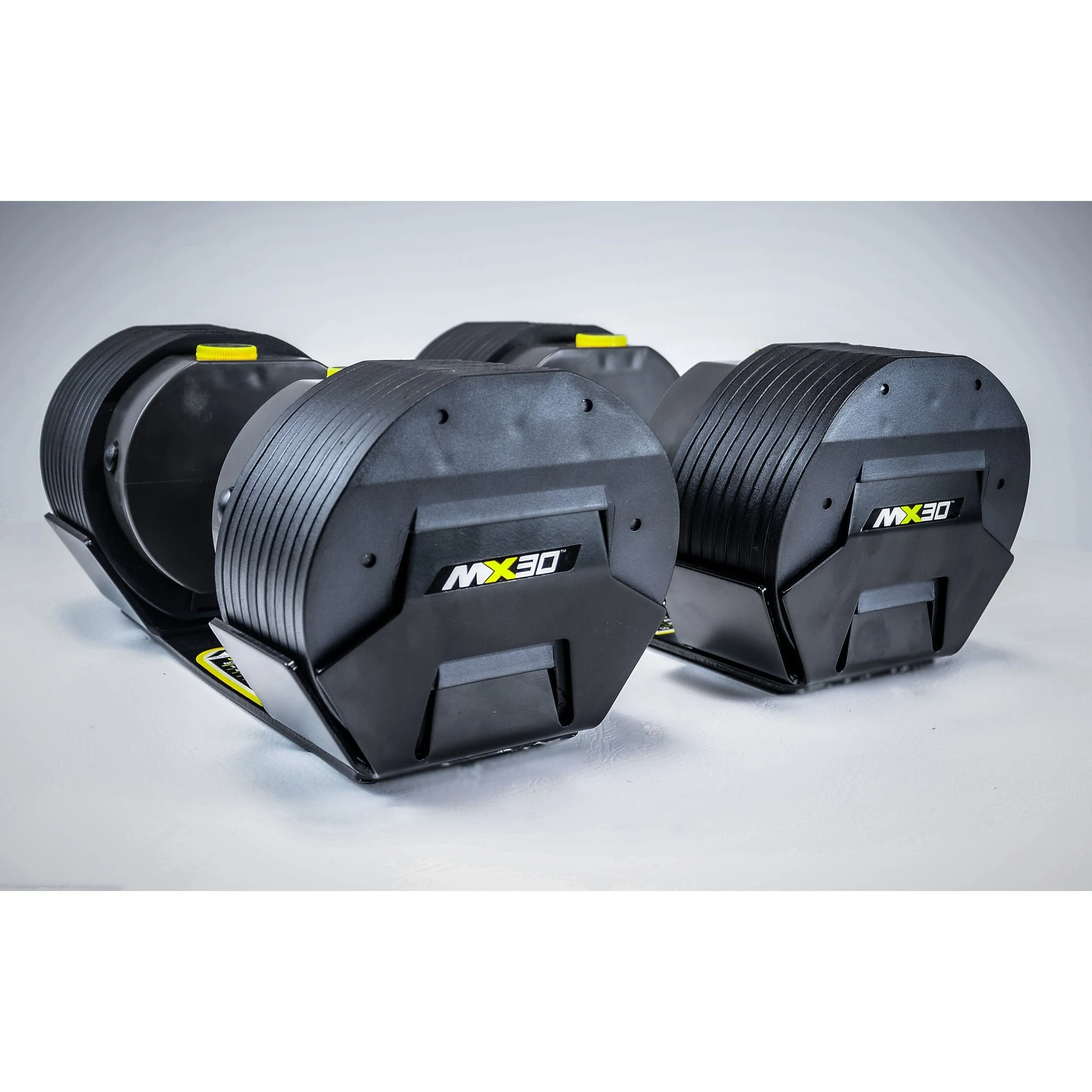
The handle is described as contoured rubber in one part of the seller’s listing and as a contoured polymer grip elsewhere. The seller gives approximate dimensions of about 36 mm grip diameter and 9.5/15.75 in dumbbell lengths; the 2022 manufacturer guide instead lists a 1.29 in (about 32.8 mm) handle diameter and 9.58/15.94 in lengths. These small but real source differences mean I do not use a single exact fit measurement in the matcher. Check the actual handle and full-load clearance if either will determine your choice. The image is an official MX30-labeled product asset, visually showing two MX30-marked handsets in cradles; its source does not disclose whether the studio image is a photograph, retouched image or render.
How to use this assessment
Think of the MX30 as a historical reference for someone comparing a light-start, 30 lb MX Select system—not as a way to buy into the current EVO accessory ecosystem. Its ordinary 7.5–30 lb balanced range is well specified, and the manual explicitly names MX30, but the retailer does not link a revision number to the prior-year clearance offer. The exact U.S. page was sold out when checked. If a secondhand unit is under consideration, confirm that both MX30 handsets, both matching cradles and the relevant instructions are present, and inspect selector function before use. For a current system or a route to higher capacity, compare the separate EVO family reviews rather than assuming compatibility.
Key details at a glance
| Starting load used for comparison | 7.5 lb per hand |
|---|---|
| Included maximum | 30 lb per hand |
| Weight change | dual_dial |
| Supplied grip surface | soft |
| Supplied configuration | Exact U.S. clearance listing says Pair. Official guide/brochure show a pair with weight plates and one selector cradle per handset. Stand and bench are optional; EVO magnetic add-ons are explicitly incompatible. |
Use the exact model’s instructions for operating limits, supplied equipment and version differences.
Sources for this assessment

Put the lightest and heaviest loads together.
Add the adjustment method, an exact selection or a grip requirement when it matters.