
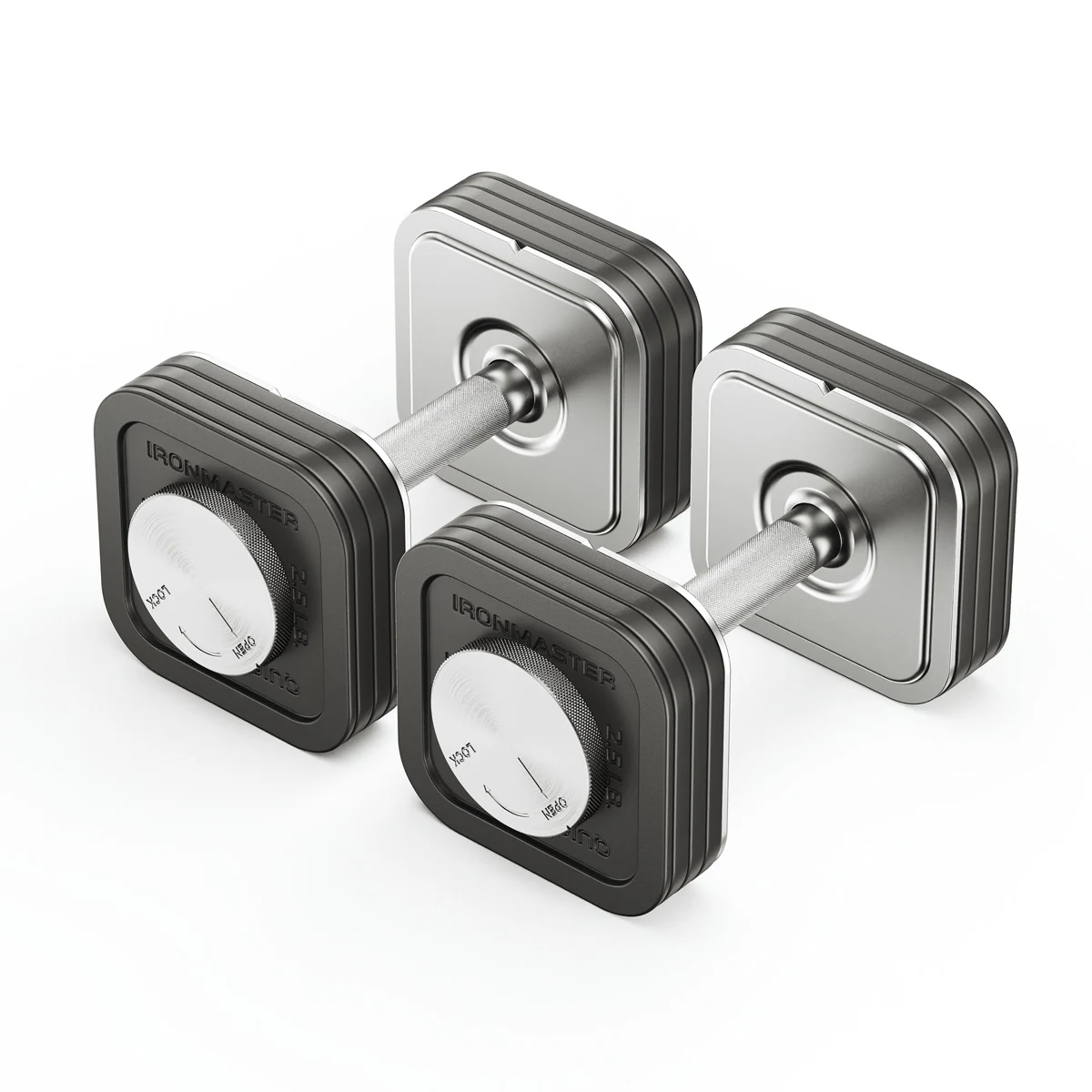
Your needs, this model
Does it fit your priorities?
Does the included pair reach 45 pounds per hand?
Yes. This is the base 45-pound pair, with optional upgrades separate.
Explore this need in the finder →Can I use an exposed knurled grip and expand later?
Yes. The Original 45 has knurled steel grips and a compatible expansion route.
Explore this need in the finder →Is a securely assembled five-pound start confirmed?
No. The listed handle and both locking screws total ten pounds; the conflicting headline is not used as a secure operating minimum.
Explore this need in the finder →The Original Quick-Lock 45-pound pair is for a buyer who prefers an exposed knurled metal handle and physically loaded plates to a selector stack. It trades instant selection for a compact plate-loaded shape and a documented upgrade route. Its most important qualification is the starting weight: the manufacturer's headline says five pounds, while the listed handle and locking screws total ten pounds before plates are added.
Understand the assembled starting point
The package contains two handles, four locking screws, twelve five-pound plates and four 2.5-pound plates. Ironmaster describes each handle as five pounds and each locking screw as 2.5 pounds. A handle with both screws therefore totals ten pounds. The companion Original 75-pound page explicitly describes that ten-pound starting assembly. We use ten pounds as the conservative assembled comparison floor for this shared handle-and-screw system.
The current product page links operating instructions covering both the Original 45 and 75 configurations. That document expressly calculates ten pounds for a handle with two locking screws. Its five-pound empty-handle figure should not be read as permission to omit securing parts during a loaded exercise. If a sub-ten-pound assembled load is essential, this pair does not provide a confirmed fit.
Plate changes are part of the appeal and the work
The Quick-Lock design uses locking screws that release with a partial turn, followed by adding or removing plates and securing the assembly again. This differs from moving a selector pin or twisting a handle in a cradle. It can suit someone who repeats several sets at the same weight and accepts a deliberate change between exercises. It is a less natural choice when the main priority is frequent, closely timed load changes.
The linked instructions explain the 2.5-pound half steps: add one 2.5-pound plate to one end and position the hand slightly toward the heavier end. Matching plates on both ends instead produces five-pound changes. This difference matters if you want equal end loading. Our finder keeps the equal-end arrangement separate from the documented offset method, so it will not promise equal loads and a continuous 2.5-pound ladder together.
A shorter base package with room to grow
The stated full-load size at 45 pounds is 6.7 inches square and 11.5 inches long. The page also gives a nine-inch length at 20 pounds, showing why the loaded configuration matters when comparing dimensions. The exposed grip is 6.5 inches inside the ends and 1.25 inches in diameter, with a chrome-plated knurled steel surface. These dimensions offer a different hand space from a block frame without establishing a personal comfort verdict.
The Original 45 can be expanded to 75 pounds using the compatible additional plates and existing base screws. Higher-capacity kits use the appropriate longer locking hardware. Those kits are separate purchases, and their possible future capacity does not make the supplied 45-pound pair a 75- or 120-pound set today. The optional Heavy Handle equipment is also outside this base configuration.
Deciding between 45 and 75
Choose the 45-pound package when its present capacity covers your intended exercises and you prefer postponing extra plates. Choose the 75-pound base pair if you already need more than 45 pounds; that avoids an immediate separate upgrade. The lighter package is not necessarily better for light exercises, because the documented handles and locking screws are the same starting issue in both.
Allow a stable area for changing plates, not just a place to park the assembled pair. Loose plates and screws need an orderly position during a change. The base pair does not include a stand merely because product photographs elsewhere show one. Check current supplied parts carefully when comparing a set, an add-on kit and a stand bundle.
Our assessment favors the Original 45 for a buyer who wants this physical plate-loading routine and an upgrade path, with a present maximum below 45 pounds. It does not promise instant changes, equal-end 2.5-pound steps or a securely assembled five-pound minimum. Follow the current supplied operating instructions and use controlled set-downs; manufacturer durability language is not a substitute for confirming how the exact assembly must be secured.
Key details at a glance
| Starting load used for comparison | 10 lb per hand |
|---|---|
| Included maximum | 45 lb per hand |
| Weight change | screw |
| Supplied grip surface | knurled |
| Grip diameter | 31.75 mm |
| Full-load length | 11.5 in |
| Full-load width | 6.7 in |
| Full-load height | 6.7 in |
| Supported upgrade beyond this package | Yes |
| Supplied configuration | Two handles, four screws, twelve 5 lb plates and four 2.5 lb plates; stand separate. |
Use the exact model’s instructions for operating limits, supplied equipment and version differences.
Sources for this assessment
Put the lightest and heaviest loads together.
Add the adjustment method, an exact selection or a grip requirement when it matters.